
 by

Israel’s Sale (Apartments) Law: The Complete 2026 Guide to New Apartment Buyers’ Rights, Developer Warranties and Legal Protection
Legal Review Date: November 1, 2026 |
Jurisdiction: Israel |
Subject: New Apartment Purchases, Developer Liability and Buyer Protection
Buying a newly constructed apartment in Israel is a major financial decision.
Whether you are purchasing a family residence, vacation home or investment property, understanding your legal rights is essential.
Israel’s Sale (Apartments) Law, 5733–1973 (Chok HaMecher Dirot) provides important protections to purchasers of newly constructed apartments,
including rights concerning construction defects, building standards, developer obligations and delayed delivery.
A separate statute, the Sale (Apartments) (Assurance of Investments of Apartment Purchasers) Law, 5735–1974,
establishes legal protections for qualifying payments made to developers before construction is completed.
This guide explains how these laws work, what responsibilities developers have, how long warranties last, and what buyers should do when problems arise.
A developer’s legal responsibilities do not necessarily end when the apartment is delivered.
1. What Is Israel’s Sale (Apartments) Law?
The Sale (Apartments) Law establishes mandatory legal standards and obligations for developers and other qualifying sellers of newly constructed apartments in Israel.
The legislation provides protection in several important areas:
- Construction quality: Apartments must comply with contractual specifications, applicable official standards and building regulations.
- Construction defects: Developers remain responsible for qualifying defects during prescribed statutory periods.
- Delayed delivery: Purchasers may be entitled to monetary compensation when their apartment is not delivered on time.
- Technical specifications: Buyers must receive the legally required property specifications and relevant maintenance instructions.
- Legal remedies: Purchasers may be entitled to repairs, reimbursement or compensation depending on the circumstances.
- Mandatory rights: Developers generally cannot reduce statutory buyer protections through unfavorable contractual terms.
These protections operate alongside the apartment purchase agreement. Buyers should therefore review both the contract and the statutory requirements.
2. Which Properties and Transactions Are Covered?
The law principally applies to transactions in which a developer or another qualifying seller sells an apartment constructed or intended to be constructed for sale.
It commonly covers new apartments in residential buildings, but the statutory definition is broader than the everyday meaning of a residential apartment and may extend to other types of units.
Does the Law Apply to Second-Hand Apartments?
An ordinary resale between private homeowners is generally governed by different contractual and statutory arrangements.
However, subsequent purchasers may benefit from applicable statutory rights against the original developer where the relevant periods and legal conditions remain satisfied.
An apartment is delivered by a developer in January 2025 and subsequently sold to another buyer in January 2027. If the second purchaser discovers a qualifying waterproofing defect during the relevant statutory period, rights against the original developer may remain available.
The private resale seller’s obligations are a separate legal issue and may be governed by the general Sale Law, contractual representations and other applicable legislation.
3. What Qualifies as a Construction Defect or Non-Conformity?
The law uses the concept of non-conformity to describe situations in which the apartment or one of its components fails to satisfy relevant legal or contractual requirements.
Examples include a departure from the technical specification, failure to comply with applicable official standards, or construction that does not meet relevant building regulations.
Examples of Potential Construction Defects
- Water penetration through ceilings or exterior walls.
- Defective plumbing or drainage installations.
- Improperly installed flooring or wall tiles.
- Cracks caused by defective workmanship or structural problems.
- Faulty waterproofing beneath balconies or roofs.
- Improper window installation.
- Heating or hot-water equipment failures.
- Defects in external building cladding.
- Materials or installations that do not conform to the signed specification.
A developer promises a particular type of window glazing in the signed technical specification but installs a different product that fails to comply with the agreement. Even if the windows appear usable, the discrepancy may constitute legal non-conformity.
Not every cosmetic imperfection automatically creates developer liability. The legal classification depends on the relevant obligations, the cause of the problem, its severity, the delivery date and the applicable statutory provisions.
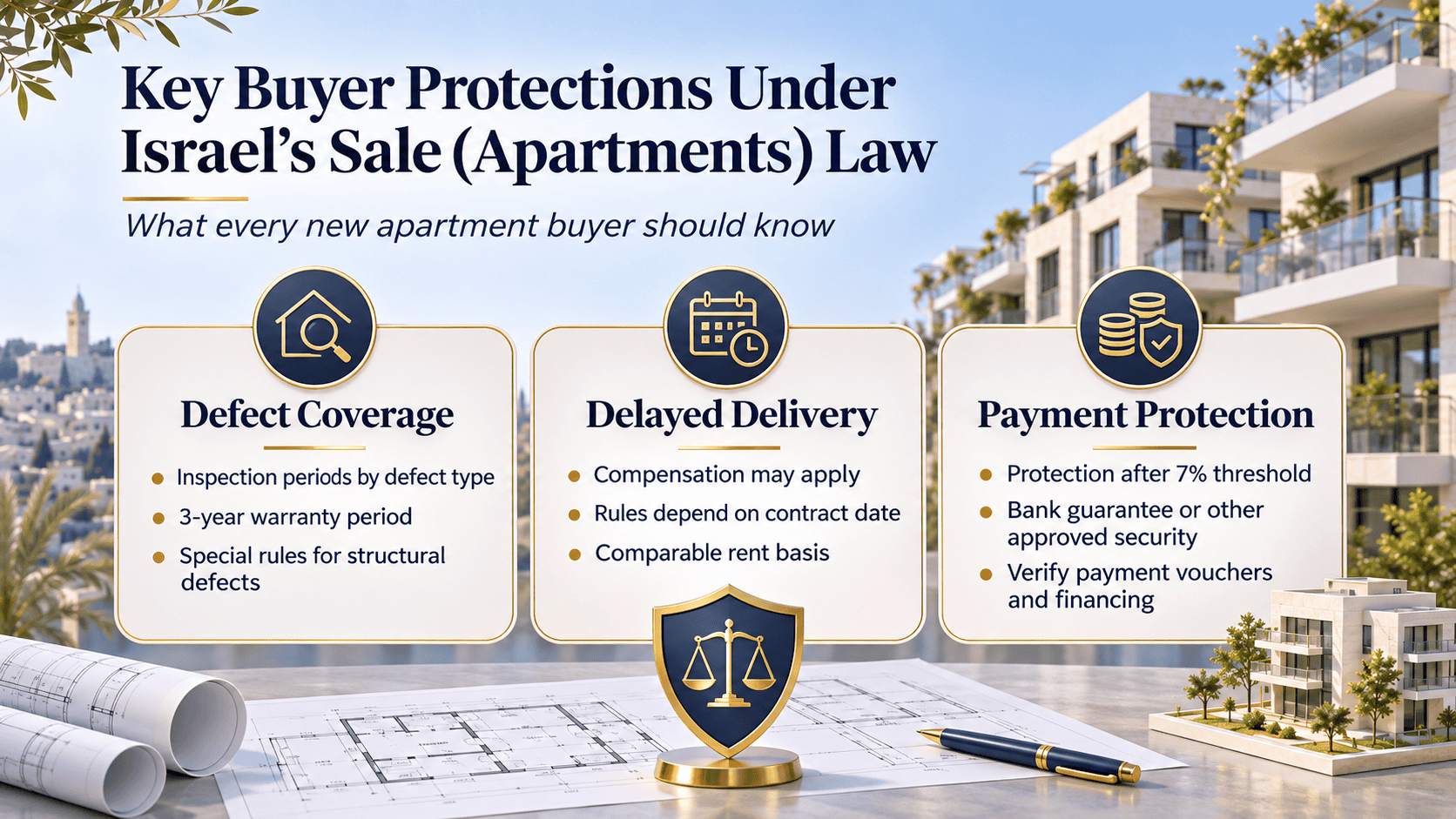
4. Understanding Inspection Periods and Warranty Periods
The Sale (Apartments) Law distinguishes between two important periods of developer responsibility.
The Inspection Period — Tekufat Bedek
The inspection period begins when possession of the apartment is transferred to the purchaser.
Its duration depends on the type of defect.
During this period, the developer is generally responsible for a qualifying non-conformity unless the developer proves that it was caused by an act or omission of the purchaser or a subsequent purchaser.
The Warranty Period — Tekufat Acharayut
Following the relevant inspection period, an additional three-year warranty period applies.
During this warranty period, the buyer must prove that the non-conformity originated in the design, work or materials.
During the inspection period, the developer generally bears the burden of establishing buyer-caused damage. During the subsequent warranty period, the buyer must prove the qualifying construction-related origin of the defect.
These statutory liability periods should not be confused with the separate limitation period for filing legal proceedings.
5. Complete Table of Statutory Construction Defect Periods
The following table summarizes the principal inspection periods prescribed by the Schedule to the Sale (Apartments) Law for apartments governed by the relevant post-2011 statutory framework.
| Type of Defect | Inspection Period | Additional Warranty |
|---|---|---|
| Metalwork and carpentry products, including aluminum and plastic components | 2 years | 3 years |
| Interior flooring and wall cladding defects, including subsidence and abnormal wear | 2 years | 3 years |
| Failure in the function or durability of machinery and boilers | 3 years | 3 years |
| Outdoor development works, including pathways, parking surfaces, fencing and relevant site systems | 3 years | 3 years |
| Failure of thermal insulation system components | 3 years | 3 years |
| Water, heating, gutter, waste and sewage piping systems, including leaks | 4 years | 3 years |
| Building waterproofing, including underground spaces, walls, roofs and ceilings | 4 years | 3 years |
| Cracks wider than 1.5 mm in non-load-bearing components | 5 years | 3 years |
| Detachment, peeling or disintegration of exterior cladding | 7 years | 3 years |
| Other non-conformities not classified as fundamental structural defects | 1 year | 3 years |
Note: Each additional three-year warranty period begins after the relevant inspection period ends. Earlier transactions may be governed by different rules due to transitional provisions.
Example: A Waterproofing Failure
An apartment is delivered on March 1, 2026.
- Applicable waterproofing inspection period: 4 years.
- Inspection period ordinarily ends: March 1, 2030.
- Additional warranty period: 3 years.
- Warranty period ordinarily ends: March 1, 2033.
The applicable burden of proof changes after the inspection period. Notification requirements, contractual circumstances and limitation rules must still be considered.
6. Special Protection for Serious Structural Defects
Fundamental structural non-conformities are governed by special provisions.
Under the statutory framework introduced in 2011, qualifying fundamental structural non-conformities are subject to a 20-year inspection period beginning when possession is delivered.
The statutory definition concerns load-bearing building components that transfer loads to the ground and affect the building’s stability and safety.
During the 20-year period, the developer generally remains responsible unless it establishes that the non-conformity resulted from an act or omission of the buyer or subsequent buyer.
After that period, liability may still be possible if the purchaser proves that the fundamental non-conformity originated in design, workmanship or materials.
Examples of Potential Fundamental Structural Defects
- Serious defects affecting foundations.
- Deficiencies in load-bearing elements that compromise structural stability.
- Qualifying failures in essential structural support components.
Not every concrete crack, settlement problem or wall defect qualifies as a fundamental structural non-conformity. Professional assessment by a structural engineer is essential.
7. Protected Rooms (Mamad) and Safety Requirements
Many apartments in Israel include a protected residential room, commonly known as a Mamad.
Protected rooms must comply with applicable construction, planning and civil defense requirements.
There is no single universal inspection period that automatically applies to every type of Mamad defect.
The relevant statutory category depends on the nature of the problem.
- A window or door installation defect may involve the rules relevant to the particular component and applicable safety requirements.
- A waterproofing failure may fall within the waterproofing inspection category.
- A qualifying structural defect may require examination under the special rules governing fundamental structural non-conformities.
Buyers should use qualified professionals to assess protected-room deficiencies and should avoid unauthorized modifications to protected-room structural or safety systems.
8. How and When Must Buyers Report Construction Defects?
Section 4A establishes important rules concerning notification of non-conformities.
Defects Discoverable at Handover
Where a defect could reasonably have been discovered when possession was transferred, the purchaser must generally notify the seller within one year after delivery.
Hidden Defects Discovered Later
If a defect could not reasonably have been discovered during a handover inspection, the purchaser must notify the developer within a reasonable time after discovering it.
How Should Buyers Report a Defect?
Although the statute does not impose a universal written-form requirement for every notice, written notification is strongly recommended.
A good notice should contain:
- The apartment address and project details.
- The date the defect was discovered.
- A detailed description of the problem.
- Photographs or relevant supporting documents.
- A request for inspection and appropriate repair.
- Contact information and a request for written acknowledgment.
Keep copies of every notification, response, professional report and repair record.
9. What Must the Developer Repair, and How Quickly?
Under Section 4B, where a qualifying non-conformity can be repaired, the purchaser must generally provide the seller with an appropriate opportunity to correct it.
The repair must be carried out within a reasonable time.
The law does not prescribe one universal deadline for every type of repair. The urgency, severity, nature and circumstances of the defect are relevant.
What If the Developer Repeatedly Fails to Repair?
Section 4B provides additional remedies in specific circumstances, including certain recurring defects following unsuccessful repair attempts and urgent defects that have not been corrected within a reasonable time.
Where the statutory requirements are satisfied, the purchaser may be entitled to arrange repairs and require the developer to bear their cost.
Can the Purchaser Demand Money Instead of Repairs?
Depending on the circumstances, remedies may include reimbursement of qualifying repair costs, damages or other relief.
However, an immediate right to demand cash instead of allowing the developer to repair is not automatic.
Before commissioning expensive independent repairs, purchasers should ordinarily obtain professional legal advice and preserve evidence, except where urgent action is reasonably necessary.
10. The Apartment Handover Protocol: What Should Buyers Inspect?
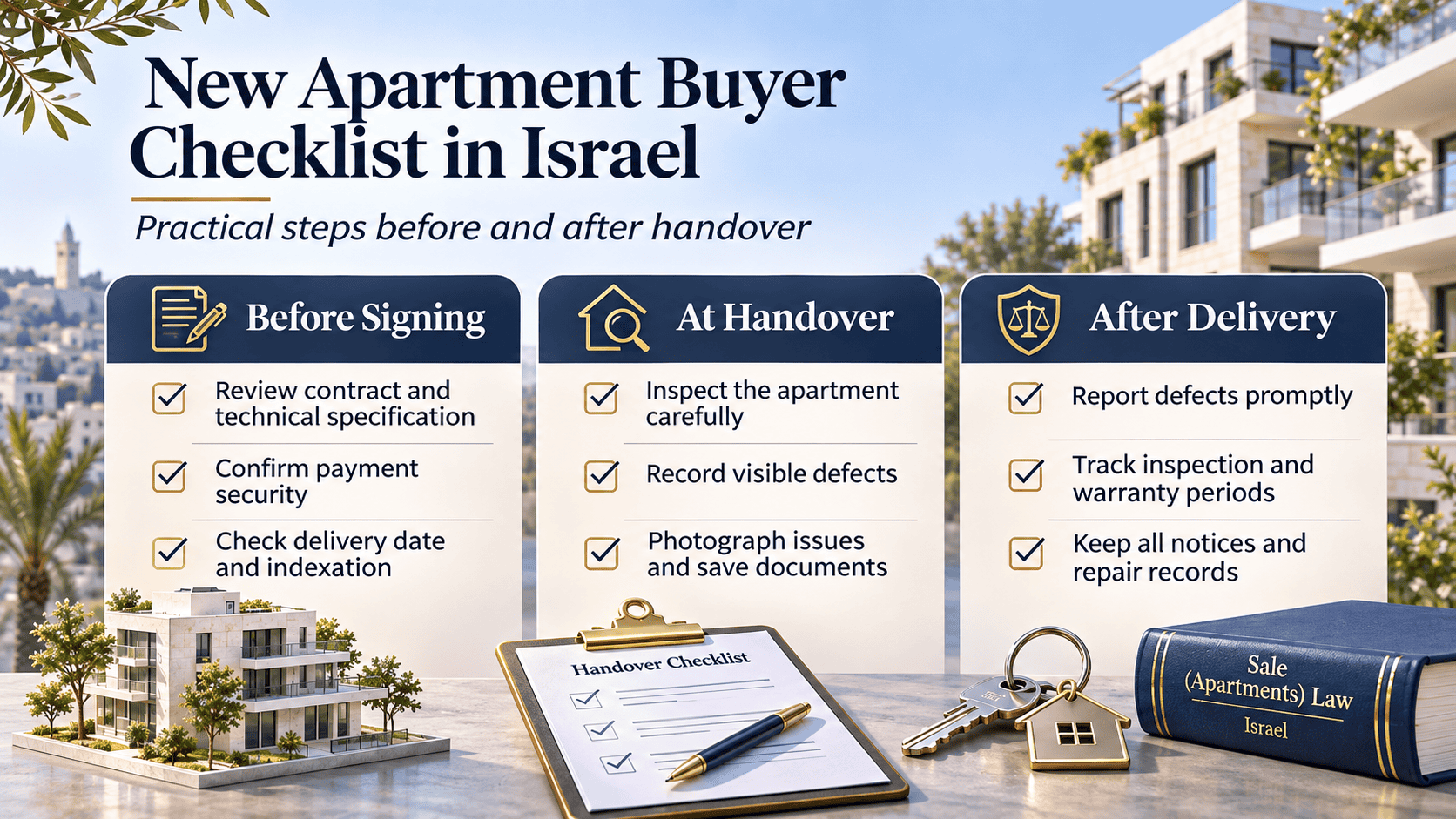
The handover protocol documents the condition of the apartment when the developer transfers possession.
It is an important evidentiary document, but signing it does not automatically extinguish statutory rights concerning later-discovered defects.
Recommended Handover Inspection Checklist
- Windows, shutters, doors, frames and locks.
- Flooring, tiles and wall finishes.
- Water pressure and plumbing fixtures.
- Drainage systems and visible leaks.
- Electrical outlets and lighting points.
- Heating, cooling and hot-water equipment.
- Balconies, railings and drainage outlets.
- Protected-room equipment and accessible components.
- Storage rooms and parking spaces.
- Relevant common areas and shared installations.
- Compliance with the agreed technical specification.
Should Buyers Hire an Independent Engineer?
An independent property inspection, commonly called Bedek Bayit in Israel, can help identify visible construction deficiencies and document them professionally.
This is particularly valuable before or shortly after possession is transferred.
Never rely solely on verbal promises that defects will be corrected. Record visible problems in the handover documents and retain photographs and written correspondence.
11. Compensation for Delayed Apartment Delivery in Israel
Section 5A establishes statutory compensation for qualifying delays in delivering newly constructed apartments.
The compensation mechanism depends on the date the purchase contract was signed.
Contracts Signed on or After July 7, 2022
For contracts governed by Amendment No. 9, the compensation framework is based on the reasonable rent of a comparable apartment in the same area.
| Period of Delay | Statutory Compensation | First month after the contractual delivery date | No compensation under Section 5A | Second through fourth months | 100% of comparable monthly rent | Fifth through tenth months | 125% of comparable monthly rent | Eleventh month onward | 150% of comparable monthly rent |
|---|
The law also provides rules for a month or part of a month and recognizes higher contractual compensation where applicable.
Example: Seven Months of Delayed Delivery
Assume an apartment’s comparable market rent is NIS 8,000 per month and delivery is delayed by seven complete months.
- First month: NIS 0.
- Months 2–4: 3 × NIS 8,000 = NIS 24,000.
- Months 5–7: 3 × NIS 10,000 = NIS 30,000.
Total illustrative compensation: NIS 54,000.
This calculation assumes a qualifying delay without an applicable statutory exemption.
Contracts Signed Before July 7, 2022
The earlier compensation framework generally applies to qualifying delays exceeding 60 days after the contractual delivery date.
Where its conditions are satisfied, compensation is calculated retroactively from the contractual date, generally at 150% of comparable rent for the first eight months and 125% beginning with the ninth month.
Can Developers Avoid Compensation Because of External Events?
Not automatically.
For contracts governed by Amendment No. 9, statutory exceptions include delays caused solely by the buyer’s acts or omissions and circumstances satisfying the relevant legal requirements of contractual frustration.
Claims concerning security events, labor shortages, supply disruptions or other external events must be assessed individually.
A general assertion that an event was beyond the developer’s control is not, by itself, conclusive.
12. Bank Guarantees and Protection of Buyers’ Payments
Payments made before construction is completed are principally protected by the Sale (Apartments) (Assurance of Investments of Apartment Purchasers) Law, 1974.
Under Section 2, a qualifying seller generally may not receive more than 7% of the apartment’s purchase price unless one of the recognized statutory protections has been provided.
What Forms of Protection Are Permitted?
The statutory framework recognizes several alternatives, including:
- A qualifying bank guarantee or other legally authorized guarantee.
- A qualifying insurance policy.
- A first-ranking mortgage satisfying the statutory requirements.
- A qualifying cautionary notice, known as He’arat Azhara.
- Qualifying transfer of ownership or other property rights free of disqualifying third-party rights.
Is a Bank Guarantee Always Mandatory?
No. A bank guarantee is a common and important mechanism, but the legislation permits other qualifying forms of security.
Buyers should verify which mechanism applies and whether it satisfies the applicable statutory requirements.
Does the Guarantee Cover VAT?
The statutory guarantee and insurance mechanisms generally exclude the VAT component, with a separate statutory mechanism addressing the VAT portion in qualifying realization circumstances.
Accordingly, the entire protection arrangement should be reviewed rather than relying exclusively on the face value of a guarantee certificate.
Project Financing and Payment Vouchers
Where the project operates under the applicable financial-accompaniment framework, payments are generally made through official project vouchers.
Buyers should confirm the project account details independently and follow the legally required payment procedures.
Do not transfer substantial purchase payments to an unverified account. Confirm payment instructions directly with the authorized project representatives and the relevant financial institution.
The purchaser-investment protection law was also amended in March 2026, making verification of the current statutory security arrangements especially important.
13. Construction Cost Indexation and Apartment Price Increases
The Israeli Residential Construction Input Price Index may affect the final amount payable under certain new-apartment contracts.
For contracts signed on or after July 7, 2022, Section 5C restricts the developer’s ability to link purchase payments to that index.
Under the relevant statutory arrangement, the first 20% of the contractual apartment price is protected from indexation, and generally up to half of each qualifying subsequent payment may be linked to the index.
Under a conventional payment structure, this means that approximately 40% of the total apartment price may be exposed to indexation.
Indexation Example
Assume the contractual price of a new apartment is NIS 3,000,000.
If NIS 1,200,000 is exposed to construction indexation and the relevant cumulative index increase is 5%, the additional amount would be NIS 60,000.
This simplified illustration does not replace a calculation based on individual installment dates, published index values and the actual contract.
Buyers should examine the payment schedule and indexation provisions before signing, especially when the expected completion date is several years away.
14. Technical Specifications: What Must the Developer Deliver?
The legally required technical specification, known as the Mifrat, is a central document in a new-apartment transaction.
It identifies the apartment’s promised characteristics, materials, installations and other relevant technical details.
The developer must provide the required specification and relevant maintenance and use instructions in accordance with the statute.
Why Does the Technical Specification Matter?
It helps establish what the buyer is contractually entitled to receive.
Examples include:
- Flooring materials and finishes.
- Kitchen configurations and installations.
- Electrical and plumbing specifications.
- Window and glazing characteristics.
- Sanitary fixtures.
- Heating and cooling arrangements.
- Relevant building and apartment components.
Buyers should keep signed copies of the specification, plans, contract amendments and approved upgrade orders.
Where the seller fails to provide the required specification, the law establishes specific legal consequences concerning items that should have been specified.
15. Developer Responsibility for Common Areas and Shared Property
Construction defects may affect not only individual apartments but also common property.
Examples include:
- Roof waterproofing.
- External walls and cladding.
- Shared plumbing and drainage.
- Parking structures.
- Common access paths.
- Shared installations and infrastructure.
Responsibility and the relevant inspection period depend on the nature of each defect.
Claims involving common property may also require coordination between apartment owners, the homeowners’ association and authorized representatives.
16. Can a Developer Require Buyers to Waive Their Rights?
Section 7A generally prohibits contractual provisions that derogate from the protections of the Sale (Apartments) Law to the buyer’s disadvantage.
A developer therefore cannot simply eliminate mandatory statutory rights by inserting a broad exclusion clause in the purchase agreement.
The law also provides specific protection against certain waivers imposed as conditions of apartment handover, defect repairs or transfer of rights.
A developer asks a purchaser to sign a document releasing the developer from all statutory construction-defect liability as a condition of receiving the keys. Such a requirement may be invalid under the applicable legal provisions.
The validity of a separately negotiated settlement concerning an existing dispute requires individual legal analysis.
17. What If the Developer Refuses to Repair Construction Defects?
If a developer refuses to accept responsibility, buyers should approach the dispute systematically.
Step 1: Document the Defect
Take photographs, record the date the problem appeared and preserve all correspondence.
Step 2: Obtain an Independent Engineering Opinion
A qualified building engineer can assess the likely cause, severity, repair method and estimated repair cost.
Step 3: Send Formal Notice
Describe the problem clearly and request an inspection and appropriate repair.
Step 4: Allow an Appropriate Opportunity for Repair
Where Section 4B applies, the developer must generally be given an appropriate opportunity to correct the defect.
Step 5: Consider Legal Remedies
If the problem remains unresolved, independent legal counsel can evaluate possible claims, recoverable expenses, procedural requirements and applicable deadlines.
Buyers should avoid unnecessary delays because the expiry of a statutory inspection or warranty period does not necessarily correspond to the limitation deadline for filing a claim.
18. Special Considerations for Foreign Buyers and Overseas Investors
International buyers purchasing a new apartment in Israel often face additional challenges, including language barriers, remote documentation, unfamiliar financing arrangements and difficulties attending the property handover.
Before Signing the Purchase Agreement
- Appoint an independent Israeli real estate attorney.
- Request a clear explanation or reliable translation of important contractual provisions.
- Verify the developer’s rights to the land and relevant project authorizations.
- Review the technical specification and approved plans.
- Confirm the applicable protection for purchase payments.
- Examine the contractual delivery date and compensation provisions.
- Understand construction cost indexation.
- Review tax and registration implications separately.
Before Receiving the Keys
Overseas buyers who cannot attend personally should consider appointing an authorized representative and an independent property inspector.
The inspector can document visible defects and identify issues requiring specialist investigation.
After Delivery
Buyers should retain all documents, monitor defects, maintain reliable contact information and ensure the apartment is inspected periodically if it remains vacant.
Independent legal representation, properly documented payments and professional property inspections are particularly valuable when purchasing an Israeli apartment remotely.
19. Frequently Asked Questions About Israel’s Sale (Apartments) Law
How long is a developer responsible for construction defects?
The duration depends on the defect category. Under the relevant modern statutory schedule, ordinary inspection periods generally range from one to seven years, followed by an additional three-year warranty period. Special rules apply to qualifying fundamental structural non-conformities.
Does the law apply to second-hand apartments?
A conventional private resale is generally governed by different rules. However, a subsequent buyer may retain applicable statutory rights against the original developer if the legal conditions and relevant periods are satisfied.
Can I report defects after signing the handover protocol?
Yes. Signing the protocol does not automatically eliminate statutory rights relating to defects discovered later. The buyer must comply with the applicable notification and evidentiary requirements.
Who must prove that a defect was caused by the buyer?
During the applicable inspection period, the developer generally bears the burden of proving that a qualifying defect was caused by an act or omission of the buyer or subsequent buyer. During the additional warranty period, the buyer must prove that the defect originated in the design, work or materials.
Is the developer responsible for water leaks?
Qualifying waterproofing and piping failures may fall within four-year inspection periods followed by an additional three-year warranty period. The precise category depends on the underlying cause and the relevant statutory provisions.
What compensation is available for delayed delivery?
For contracts governed by Amendment No. 9, compensation generally begins after the first month of delay and is calculated according to comparable rental value at rates of 100%, 125% and 150% for the relevant periods. Older contracts may be governed by a different calculation mechanism.
Is a bank guarantee mandatory for every new apartment?
Not necessarily. The purchaser-investment protection law allows several legally recognized security alternatives. However, a qualifying seller generally cannot collect more than 7% of the apartment price without providing the required statutory protection.
Can a developer require me to waive statutory rights?
The law generally prohibits contractual provisions that reduce mandatory buyer protections. Specific statutory restrictions also apply to certain waivers imposed as conditions of delivery, repairs or transfer of rights.
Can I bring a claim after the warranty period expires?
Possibly. The answer depends on the defect, notification history, applicable limitation rules, available causes of action and special statutory provisions. Fundamental structural defects are subject to separate rules.
Should foreign buyers hire an independent Israeli lawyer?
Yes, this is strongly recommended. Independent counsel can review the purchase agreement, verify property rights and payment protections, and advise on delivery obligations, registration and transaction-specific legal risks.
20. Practical Checklist for New Apartment Buyers in Israel
Before Signing
- Verify the developer’s identity and relevant property rights.
- Appoint independent legal representation.
- Review the technical specification and building plans.
- Confirm the required security for payments.
- Examine the delivery date and compensation provisions.
- Understand the payment schedule and indexation clause.
At Handover
- Arrange a professional property inspection.
- Record visible defects in the handover protocol.
- Photograph relevant deficiencies.
- Collect the required operating and maintenance documentation.
- Keep evidence of the actual possession date.
After Handover
- Retain all relevant contractual and inspection documents.
- Report discovered defects promptly.
- Track the applicable inspection and warranty periods.
- Document repair visits and recurring problems.
- Seek professional advice when disputes arise.
Conclusion: Understanding Your Rights Protects Your Investment
Israel’s Sale (Apartments) Law provides an important foundation for protecting purchasers of newly constructed property.
Its protections cover construction quality, contractual specifications, defect liability and delayed delivery, while separate legislation protects qualifying purchaser payments during construction.
Understanding these rules before signing the purchase agreement can help buyers identify potential risks, preserve legal rights and avoid costly disputes.
The best approach combines independent legal advice, carefully reviewed contracts, professional construction inspections and proper written documentation throughout the transaction.
For both Israeli residents and international property buyers, informed preparation is one of the most valuable ways to protect a real estate investment.
Legal Sources and Official References
The following sources provide the primary statutory framework and official buyer information.
Sale (Apartments) Law, 5733–1973 — Israel National Legislation Database
Sale (Apartments) (Assurance of Investments of Apartment Purchasers) Law, 5735–1974
Israel Ministry of Construction and Housing — Guide for New Apartment Buyers
Consolidated Hebrew Text — Sale (Apartments) Law
Legal Review Date: November 1, 2026.
Legal Disclaimer:
This article is provided for general educational and informational purposes only. It does not constitute legal advice or a legal opinion. The applicable statutory provisions may differ according to the date of the purchase agreement, transitional arrangements, property circumstances and relevant legal developments. Readers should consult a qualified Israeli real estate attorney regarding their specific transaction or dispute.


Join The Discussion